
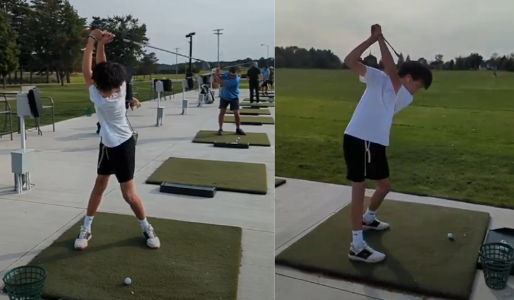
How I Teach Golf (Inspired by Kelvin Miyahira) is a 12-part series on MyJLStory.com. Each post shares one of my personal takeaways from studying Kelvin’s biomechanical framework and refining it through years of teaching. These are not a direct representation of Kelvin’s teaching — they are my interpretations, shaped by my own experience and mistakes. Start here, then follow the series for a full picture.
The backswing doesn’t get the credit it deserves. Most golfers treat it like a wind-up — just get to the top, then the “real” swing starts. But Kelvin’s work taught me something different: the backswing is where the engine gets loaded.
Small details here determine whether the downswing flows or fights.
Here’s what I now look for:
- Right-side lateral bend during takeaway.
A small “side crunch” that lets the body coil without drifting off the ball. - Progress into left lateral bend + thoracic extension at the top.
This spine engine pairing creates rotational space — not collapse. - Trail hip external rotation + extension -> trail hip internal rotation; lead hip internal rotation.
These micro-moves allow the hips to turn deeply without lateral slide. - Head movement managed, not frozen.
A little upward motion is natural — even helpful. But too much lift causes the pelvis to drift toward the ball, setting up “goat hump” later.
Kelvin explains this in his Micro Moves of a Correct Backswing article.
For years, I tried to “lock down” my hips and freeze my head, thinking that’s what stability meant. The result?
- A flat backswing.
- A loss of posture.
- A downswing that only worked when perfectly timed.
Kelvin’s framework flipped that.
Once I let my trail hip move deep, my lead hip stay high, my spine extend, and my head move naturally instead of rigidly, rotation became effortless.
One student told me:
“I feel like I’m overswinging, but doing it easier — more shoulder and hip turn, more T-spine extension, higher hands — and the ball is going further.”
That’s the point. We don’t shy away from big movements.
We encourage full hip turns, full shoulder turns, thoracic extension, and high hands — but only when the body moves in sequence, not in conflict.
[Photo Placeholders]
- Takeaway — showing right-side lateral bend
- Top of backswing — left lateral bend + lumbar extension
- Hips — trail hip deep, lead hip high
- Side-by-side — head stable vs. excessive rise
- Full turn with high hands
Closing Theme
The downswing starts in the backswing. Build it with precise micro-movements — and don’t be afraid of full, expansive turns.
Power shows up when the engine is loaded and connected, not when it’s restricted.
Call to Action
This is part of my How I Teach Golf (Inspired by Kelvin Miyahira) series.
Have you ever felt like swinging bigger actually made things easier? Share your story in the comments — I’d love to hear it.
Editor’s Note
We’re still gathering the right swing photos and visuals for this series. Placeholders mark where they’ll go — thanks for your patience as we complete this resource.