
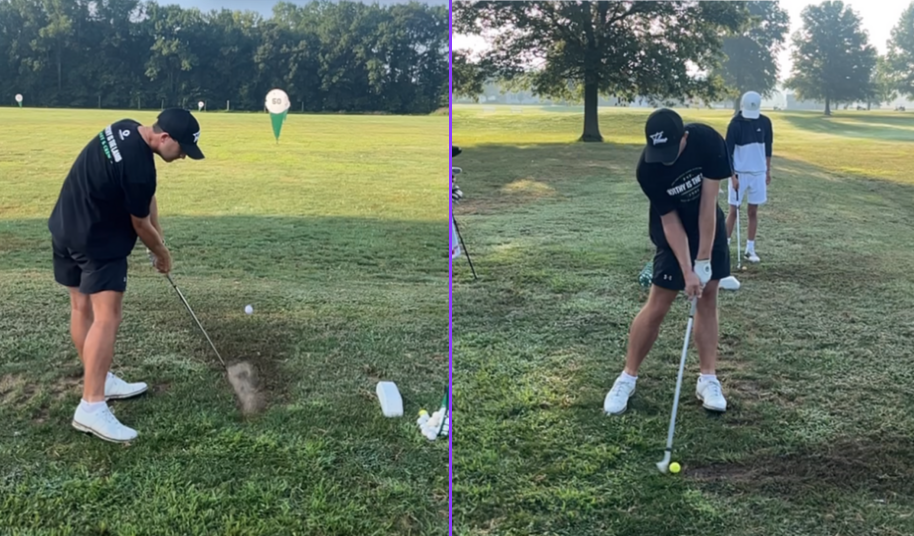
The morning after a high school golf fundraiser, Xander and I found ourselves on the range at a local muni course. He had been hitting what he called “wipey” shots the day before—glancing impacts with good swing structure underneath. With one small position change and a new understanding of lag, he went from glancing the ball to smashing his 7-iron into the 200-yard sign. A simple, quiet lesson that unlocked speed, clarity, and confidence.
The Day After the Outing
During the high school team fundraiser the day before, I watched Xander hit shot after shot that looked solid but lacked compression. He called it “wipey.” I called it a glancing blow. It’s the kind of contact where the clubface just skims across the ball instead of driving through it.
Aside from that, his golf swing was in great shape. Balanced, athletic, and connected. It was clear he understood his swing. But something was off.
Warming Up at the Muni
The next morning, we headed to the range at a local muni course. I asked him to warm up.
“How long has this impact pattern been like this?”
As we talked, I watched him move. He was already working on a correction, trying to get the club into a better position. The effort was good, but the feel was slightly off.
What I noticed was this: during his downswing, when the shaft was parallel to the ground, he was placing the clubhead just outside his hands. That’s a great takeaway position—but it’s not the right place during the downswing.
A Small Fix, A Big Shift
That little detail told me a lot. He wasn’t guessing—he had a clear feel for his swing. He just needed a slight adjustment.
I told him:
“When your shaft gets parallel to the ground on the downswing, the clubhead should be between your hands and your thigh. Not outside your hands.”
He made the change.
And it clicked.
He started compressing the ball, flighting it lower with more speed and consistency. The glancing contact disappeared. The ball was jumping off the face.
Letting Go of Tension: Understanding Lag
As we worked, I also noticed he was trying hard to hold lag—almost forcing it. That’s a common thing in junior golfers. They see pros with big lag angles and try to muscle the club into that position.
I explained it like this:
“Lag isn’t something you create by force. It’s something you allow to happen.”
Lag comes from soft wrists and relaxed arms. It shows up when the core starts the downswing, and the arms and wrists naturally fall behind like a whip.
If you’re losing lag too early, the problem usually isn’t your wrists or elbows—it’s how your body is moving. Most of the time, it’s about your shoulders, chest, hips, or legs not working in sync.
As soon as he stopped trying to “hold” lag and started letting his body lead the motion, everything smoothed out.
A 200-Yard Confirmation
With the right shaft position and a better understanding of lag, his swing transformed.
Then came the highlight.
He launched his 7-iron and hit the 200-yard sign dead center.
We both looked at each other and smiled. No words needed.
One More Observation: The Return of an Old Habit
Just before we wrapped up, I noticed one more thing. During his takeaway, Xander’s head was drifting slightly toward the ball. That subtle movement was pulling his club too far to the inside—a pattern we had worked hard to correct over the winter.
I reminded him:
“Old habits die hard. They always want to come back and hunt you. We need to learn to manage it.”
Swing changes aren’t always permanent. Sometimes, the best we can do is stay aware and continue to manage the pattern. Real change doesn’t always show up as a clean break from the past. More often, it’s a quiet, persistent awareness—year after year.
That moment laid the foundation for our next conversation—on managing habits and understanding that real improvement often comes from awareness. It reminded me of something I wrote in Habits in the Golf Swing and Life, where I shared how old patterns in golf mirror the routines we carry in everyday life.
Next Stop: The Putting Green
After that, we walked over to the putting green. His mind had already shifted. It was time to tune in to feel, rhythm, and touch.
That story comes next.
Takeaways for Golf Parents and Coaches:
- Glancing impact in golf often comes from a downswing path that is outside the hands on the way down to the golf ball.
- During the downswing, the clubhead should be between the hands and the thigh when the shaft is parallel to the ground
- Lag is not something to hold—it’s something to allow through sequence and softness
- In junior golf, minor adjustments often lead to major breakthroughs
- Old habits don’t always disappear—they must be managed with long-term awareness